Error loading page.
Try refreshing the page. If that doesn't work, there may be a network issue, and you can use our self test page to see what's preventing the page from loading.
Learn more about possible network issues or contact support for more help.
Title details for Before She Was Harriet by Lesa Cline-Ransome - Available

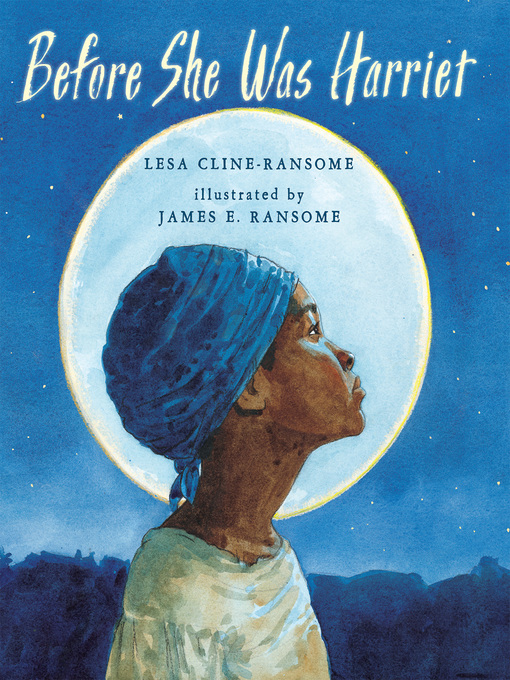
Before She Was Harriet

ebook
1 of 1 copy available
We know her today as Harriet Tubman, but in her lifetime she was called by many names. As General Tubman she was a Union spy. As Moses she led hundreds to freedom on the Underground Railroad. As Minty she was a slave whose spirit could not be broken. An evocative poem and opulent watercolors come together to honor a woman of humble origins whose courage and compassion make her larger than life. A Junior Library Guild Selection.
  • Creators

  • Publisher

  • Awards

  • Release date

  • Formats

  • Languages

  • Reviews

    • Publisher's Weekly

      Starred review from October 9, 2017
      This striking reverse chronology opens with a regal portrait of an elderly Harriet Tubman, after which the Ransomes chart her decades of work in pursuit of equality. “Before she was a suffragist/ she was General Tubman/ rising out of the fog/ armed with courage/ strong in the face of rebels,” writes Lesa Cline-Ransome, her incisive free verse emphasizing Tubman’s bravery in the face of a multitude of dangers. James Ransome’s watercolor portraits imbue Tubman with a steely determination—at every age—in lush scenes often set against blazing summer skies and blue, moonlit nights. Beyond its recognition of all that Tubman accomplished, the book serves as a powerful reminder of how all children carry within them the potential for greatness. Ages 4–7.

    • Booklist

      Starred review from September 1, 2017
      Grades K-3 *Starred Review* In reverse chronology, Harriet Tubman's multifaceted accomplishments come to life through poetic text and vivid watercolor images. Suffragist, general, spy, nurse, Aunt Harriet, Moses, conductor, Minty, Aramintaeach name she was called is briefly outlined in text that works on many levels. The poetic text and artistic presentation are simultaneously simple enough for young children to understand and sophisticated enough to inspire adults. Dramatic images, such as Tubman in a boat on the Combahee River with Union soldiers and previously enslaved people, may encourage middle- and high-school students to investigate more about her life. Recalling Tubman's association with the Underground Railroad, the Ransomes cleverly frame the story in a train journey. As Tubman boards the train, her aged face, beautiful and determined, is followed immediately by a large portrait of her in earlier days, alone under a star-filled sky. Once those associations are established, they explore each role, with subsequent page spreads depicting her work for women's rights, in the Civil War, and leading others to freedom. Taking her story all the way to childhood is an evocative way for young readers to understand how each stage of her life developed. The final page returns to Tubman on the train, continuing her journey as a free person. Libraries likely already have many Harriet Tubman books, but this well-designed, unique approach warrants making room for one more.(Reprinted with permission of Booklist, copyright 2017, American Library Association.)

    • The Horn Book

      January 1, 2018
      The Ransomes have crafted an evocative life story of Harriet Tubman, framed by her travels. In free verse, the text tells of Tubman's roles (in reverse chronological order) as suffragist, abolitionist, Union spy, nurse, conductor on the Underground Railroad, and slave. James Ransome's arresting watercolors highlight Tubman's face from different angles, always emphasizing her undaunted determination. Visual details will also enhance readers' knowledge of American history.

      (Copyright 2018 by The Horn Book, Incorporated, Boston. All rights reserved.)

    • The Horn Book

      January 1, 2018
      The Ransomes have crafted an evocative life story of Harriet Tubman, framed by her travels. On the first page, she gazes out at the reader as an elderly woman. In free verse, the text tells of Tubman's past roles (in reverse chronological order) as suffragist, abolitionist, Union spy, nurse, conductor on the Underground Railroad ("Before she was Aunt Harriet / she was Moses"), and finally Araminta, the child whose father taught her to "read" the world around her so that she would one day be free and become, simply, Harriet. James Ransome's arresting watercolor illustrations highlight Tubman's face from different angles, always emphasizing her undaunted determination amidst obstacles, as she moves from place to place. The pictures offer visual details that will enhance readers' knowledge of American history. On the title page, Tubman waits at a train station among travelers of different races, but when she finally boards the train (shown in the concluding pages of the book), an African American Pullman Porter assists her into a segregated car. When the last page returns to Tubman's image as an old woman, preparing to undertake one more journey, the lines in her face reveal the toll fighting for justice has taken on her. michelle h. martin

      (Copyright 2018 by The Horn Book, Incorporated, Boston. All rights reserved.)

    • School Library Journal

      Starred review from October 1, 2017

      Gr 3-6-Before and after Harriet Tubman became the stalwart conductor leading enslaved people to freedom on the Underground Railroad, she played many remarkable roles during her long life. Cline-Ransome honors Tubman in lyrical verse, beginning when the heroine is "tired and worn/her legs stiff/her back achy." In each stanza, Tubman looks back to the time "before she was an old woman." She recalls speaking out against injustice as a suffragist providing "a voice for women/who had none/in marriages/in courts/in voting booths." She recollects everything she accomplished during the Civil War, spying for the Union and nursing the wounded. Looking back even farther, she remembers leading her people out of bondage and then her own arduous years in the slave owners' fields. Before all of this, Tubman was a little girl named Araminta who dreamed of the time she would "leave behind slavery/along with her name/and pick a new one/Harriet." Each episode in her compelling life is illustrated by a luminous watercolor. The expertly done expressive paintings evoke Tubman's strength and integrity showing "the wisp of a woman with the courage of a lion." VERDICT This lovely tribute effectively communicates Tubman's everlasting bravery and resolve, and will inspire curious readers to learn more.-Linda L. Walkins, Saint Joseph Preparatory High School, Boston

      Copyright 2017 School Library Journal, LLC Used with permission.

    • BookPage
      Children may be familiar with the name Harriet Tubman, and they may even know some of the story of the Underground Railroad. But they probably don’t know Harriet the person—from her days before she led slaves to freedom. In a clever and poetic take on the life of this famed figure, the dynamic team of Lesa Cline-Ransome and her husband, James E. Ransome, goes backward in time. The book opens with a powerful portrait of a wizened Tubman, tired and worn from her decades of fighting for freedom. With every page turn, short verse takes readers further back, to when Tubman was a suffragist, a nurse, a Union spy, an aunt, a slave known as Minty . . . and a little girl known as Araminta. It’s important to remember Tubman’s contributions, but it’s even more important to realize that she once was a young girl, full of strength, courage and the will to do something. This is a powerful and poetic biographical sketch ideal for elementary school readers.   This article was originally published in the November 2017 issue of BookPage. Download the entire issue for the Kindle or Nook.

Formats

  • OverDrive Read
  • PDF ebook

Languages

  • English

Loading